

Some states ask for member or manager names when you form an LLC; others do not. Even without an owner field, an organizer’s name, signature or home address can identify someone connected with the company.
The table compares management-name fields in standard formation documents and required filing packages. It also flags later filings to check. These categories do not guarantee anonymity: addresses, signers, later records and bank or government identity checks still matter.
Compare every state
| State | Member / manager field | What the formation document asks for | Later filings to review | Source |
|---|---|---|---|---|
 AlabamaAL | No management roster required | The certificate lists the entity and registered-agent information; it does not require a member/manager roster. Organizer and signer information is separate. | Business Privilege Tax reviewAnnual, if tax is due | Form / statute |
 AlaskaAK | No management roster required | AS 10.50.075 lists entity, purpose, agent and management-type information without a member/manager roster. Initial and biennial reports are separate records. | Biennial ReportEvery two years | Statutory reproduction (2025) |
 ArizonaAZ | Management names required | Member-managed LLCs list all members. Manager-managed LLCs list all managers and members owning at least 20% of capital or profits. Include the required management attachment. | ACC annual reportNot required for LLCs | Rechecked Form / statute |
 ArkansasAR | Management names required | The certificate asks for at least one officer for franchise-tax purposes, with a Member or Manager title, in addition to organizer signatures. | Annual LLC Franchise Tax ReportAnnually; usual deadline May 1 | Form / statute |
 CaliforniaCA | No management roster required | LLC-1 asks for the management type rather than a membership roster. The separate initial and biennial Statement of Information has additional person fields. | Statement of InformationWithin 90 days, then every two years | Form / statute |
 ColoradoCO | No management roster required | The checklist asks who forms the LLC and whether members or managers manage it; that is not a required list of all owners. Filing-person details remain relevant. | Periodic ReportAnnually in the company’s assigned reporting period | Form / statute |
 ConnecticutCT | Management names required | List at least one manager or member with business and residence addresses. A business-only address requires an accepted good-cause exception. | Annual ReportAnnually, January 1 through March 31 | Rechecked Connecticut LLC Act |
 DelawareDE | No management roster required | The standard certificate identifies the LLC, registered office/agent and authorized signer; it does not list members or managers. | Annual LLC taxAnnually, due June 1 | Form / statute |
 District of ColumbiaDC | Management names required | List persons with more than 10% aggregate direct or indirect ownership, plus persons controlling financial/operational decisions or day-to-day operations even at 10% or less. | Biennial ReportFirst due April 1 of the next year; every two years thereafter | Rechecked DLCP ownership FAQ |
 FloridaFL | Conditional or optional listing | The articles contain an optional authorized-member/manager section. The state notes that other institutions may need it; annual-report fields must also be reviewed. | Annual ReportAnnually, by May 1 | Form / statute |
 GeorgiaGA | No management roster required | The standard articles are minimal and identify the signer and signing capacity. Organizer or agent information is not necessarily an ownership roster. | Annual RegistrationAnnually, January 1 through April 1 | Form / statute |
 HawaiiHI | Management names required | Manager-managed LLCs list initial managers; member-managed LLCs list initial members. The form also identifies organizers. | Annual ReportAnnually, in the filing quarter tied to the registration date | Form / statute |
 IdahoID | Management names required | The certificate must identify at least one governor by name and mailing address. Agent and principal-office information are separate requirements. | Annual ReportEvery year; use the due date in your SOSBiz record | Current Idaho statute |
 IllinoisIL | Management names required | The form asks for managers and any member with the authority of a manager, plus organizer information. | Annual Report (LLC 50.1)Annually; check the company’s filing deadline | Form / statute |
 IndianaIN | No management roster required | Form 49459 asks whether the company is manager-managed and identifies its signer; it does not include a required member/manager roster. The biennial report is separate. | Business Entity ReportEvery two years, in the formation anniversary month | Form 49459 (05/2024) |
 IowaIA | No management roster required | The ordinary certificate contents are company and registered-agent/office details. The organizer signing the filing is a separate role from owner. | Biennial ReportOdd-numbered years, January 1 through April 1 | Form / statute |
 KansasKS | No management roster required | The DL formation form does not require a member/manager roster. The later Information Report is a separate disclosure checkpoint. | Biennial Information Report (ILC)Every two years, due April 15 in the matching odd or even reporting year | Form / statute |
 KentuckyKY | No management roster required | The articles select manager or member management without listing a management roster. Organizers sign and the registered agent accepts appointment. | Annual ReportAnnually, January 1 through June 30 | Form / statute |
 LouisianaLA | Management names required | The required initial-report package identifies the first managers or members. If they are not yet selected, the supplemental-report instructions still need to be followed. | Annual ReportAnnually; confirm the due date on the company record | Form / statute |
 MaineME | No management roster required | The ordinary certificate identifies the registered agent and authorized signer. A professional LLC has additional requirements; the annual report is a separate filing. | Domestic LLC Annual ReportAnnually; check the state’s reporting window | Form / statute |
 MarylandMD | No management roster required | The standard articles require the resident agent and authorized-person signatures, not a membership roster. Review later annual filings separately. | Annual Report / applicable personal-property filingAnnually, generally April 15 | Form / statute |
 MassachusettsMA | Conditional or optional listing | Managers, if any, are named. The certificate also identifies people authorized to execute filings or certain property instruments; those roles are not a full ownership roster. | Annual ReportAnnually; confirm the anniversary filing deadline | Current filing instructions |
 MichiganMI | No management roster required | The ordinary articles state the entity, purpose, office/agent and management arrangement. Organizer signatures do not by themselves require a membership roster. | LLC Annual StatementAnnually, February 15 | Michigan LLC statute |
 MinnesotaMN | No management roster required | The ordinary articles identify organizers and a registered office, without a member/manager roster. Professional-firm attachments have additional requirements. | Annual RenewalAnnually | Form / statute |
 MississippiMS | No management roster required | The certificate statute lists the LLC name, registered-agent information and any specified dissolution date, without requiring a membership roster. | Domestic LLC Annual ReportAnnually; confirm the current filing deadline | Statutory reproduction (2025) |
 MissouriMO | No management roster required | The form identifies each organizer and expressly says organizers need not be members, managers or owners. It selects a management type without requiring a management roster. | Secretary of State annual reportNot required for LLCs | Form / statute |
 MontanaMT | Management names required | The articles identify initial managers for manager management, or initial members for member management, with business mailing addresses. | Annual ReportAnnually, within the January 1–April 15 filing window | Current Montana statute |
 NebraskaNE | No management roster required | The certificate identifies the company, designated office and agent. Publication and proof of publication are separate parts of the formation workflow. | Biennial ReportBy April 1 of odd-numbered years | Form / statute |
 NevadaNV | Management names required | The articles identify each initial manager or, if member-managed, each initial member, as well as organizers. Initial and annual lists add another disclosure layer. | Annual List + State Business LicenseAnnually, normally by the end of the anniversary month | NRS 86.161 |
 New HampshireNH | No management roster required | The certificate states whether members or managers manage the LLC but does not require their names in that statutory list. The annual report is separate. | Annual ReportAnnually, due April 1 | RSA 304-C:31 |
 New JerseyNJ | No management roster required | The certificate statute requires the entity name and registered-office/agent details rather than a membership roster. Review the online filing and public annual-report requirements separately. | Annual ReportAnnually, by the last day of the formation anniversary month | Statutory reproduction (2025) |
 New MexicoNM | No management roster required | The ordinary LLC Act does not require a membership roster in the articles. Registered-office, agent, organizer and record-change obligations remain. | Secretary of State periodic reportNot required for an ordinary LLC | Current LLC Act |
 New YorkNY | No management roster required | The ordinary articles identify the entity, county and service-of-process arrangements without a required membership roster. Publication and separate applicable disclosure rules still matter. | Biennial StatementEvery two years, in the original filing month | LLC Law §203 |
 North CarolinaNC | No management roster required | People executing the articles identify whether they act as members or organizers. An organizer is not necessarily an owner; the statute does not require a full membership roster. | Annual ReportApril 15 each year, starting the year after formation | G.S. 57D-2-21 |
 North DakotaND | No management roster required | The ordinary articles identify the company, office/agent and organizers without a membership roster. Agricultural and professional entities have separate rules. | LLC Annual ReportAnnually; confirm the deadline for the LLC type | N.D. Code 10-32.1-20 |
 OhioOH | No management roster required | Form 610 identifies the statutory agent and organizers, without a required member/manager roster. | Secretary of State annual reportNot required for an ordinary LLC | Current Form 610 |
 OklahomaOK | No management roster required | The ordinary articles identify the company, registered agent, principal office and signer rather than a list of members or managers. | Annual CertificateAnnually; use the due date shown for the company | Form / statute |
 OregonOR | Conditional or optional listing | Member/manager listings are provided on the form. A named individual with direct knowledge is required and may be a member, manager or authorized representative. | Annual Report / RenewalEvery year on the original filing anniversary | Form / statute |
 PennsylvaniaPA | No management roster required | The certificate identifies the entity, registered office/CROP and organizers rather than a member roster. The annual report now asks for at least one governor. | Annual ReportAnnually, January 1 through September 30 | Current certificate form |
 Rhode IslandRI | Conditional or optional listing | For manager management, the form asks for manager names and addresses if known. The instructions tell member-managed LLCs not to complete that manager chart. | Annual ReportEvery year, February 1 through May 1, after the formation year | Form / statute |
 South CarolinaSC | Conditional or optional listing | A manager-managed company lists each initial manager. The articles also identify organizers; they do not require the same management roster for every management structure. | Tax and license filingsDepends on the LLC’s tax classification and activities | S.C. Code 33-44-203 |
 South DakotaSD | Conditional or optional listing | A manager-managed LLC names each initial manager. Each organizer is identified regardless of management structure. | Annual ReportAnnually; check the due date on the business record | S.D. Code 47-34A-203 |
 TennesseeTN | No management roster required | The ordinary SS-4270 form asks for the member count and management type, with organizer signatures. Special-purpose or obligated-member elections have additional requirements. | Annual ReportAnnually, by the first day of the fourth month after fiscal-year end | Current SS-4270 |
 TexasTX | Management names required | Form 205 lists each initial manager, or each initial member if there are no managers. At least one governing person is required. | Franchise Tax / Information ReportAnnually, generally May 15 | Current Form 205 instructions |
 UtahUT | No management roster required | The current ordinary certificate statute lists entity, office and agent details without a membership roster. Professional and series provisions differ. | Renewal / Annual ReportAnnually; confirm the entity’s renewal date | Current §16-20-201 |
 VermontVT | Conditional or optional listing | The current statute makes owner, officer and other principal name/email/address information optional; each organizer is still identified. | Domestic LLC Annual ReportAnnually, within three months after the end of the LLC’s fiscal year | Current 11 V.S.A. §4023 |
 VirginiaVA | No management roster required | The ordinary articles do not list a membership roster. Registered-agent qualifications can identify an affiliation, and principal-office information is required. | Annual Registration FeeAnnually, by the last day of the formation or registration anniversary month | Virginia §13.1-1011 |
 WashingtonWA | Conditional or optional listing | Review the certificate and initial-report portions together. The initial report identifies governing people; filing the certificate alone is not the full first-year disclosure picture. | Annual ReportAnnually, by the expiration date shown on the business record | SOS online filing instructions |
 West VirginiaWV | Management names required | The articles name members authorized to execute instruments and, when manager-managed, each initial manager. Organizer information is also required. | Annual ReportEvery year after registration, January 1 through June 30 | W.Va. Code 31B-2-203 |
 WisconsinWI | No management roster required | The ordinary articles identify the entity, agent, principal office and each organizer without a member/manager roster. The annual report is a separate checkpoint. | Annual ReportAnnually; confirm the reporting quarter for the company | Wis. Stat. 183.0201 |
 WyomingWY | No management roster required | The standard articles identify the entity, office/agent, organizer and contact details, without requiring a member/manager roster. Later signatures and filings can still reveal information. | Annual Report / License TaxAnnually; confirm the entity’s anniversary deadline | Form / statute |
No states match those filters.
What the three categories mean
No management roster required means the reviewed ordinary formation form or statutory contents do not require a list of members or managers as such. It does not mean the document has no names. Agents, organizers, authorized signers and contacts can still be identified.
Conditional or optional listing means the fields depend on the management structure, are expressly optional, or need to be read together with a companion/initial filing. Read the row for the condition that applies to your filing.
Management names required means the reviewed filing asks for management, governor or qualifying owner information. It does not necessarily mean that every beneficial owner is listed: the particular role and threshold still matter. DC’s beneficial-owner rules, for example, are a different disclosure framework from a simple organizer signature.
Public filings are not bank and tax records
Banks, tax authorities, licensing bodies, business counterparties and courts may need information that does not appear in a public formation record. Check those requirements separately.
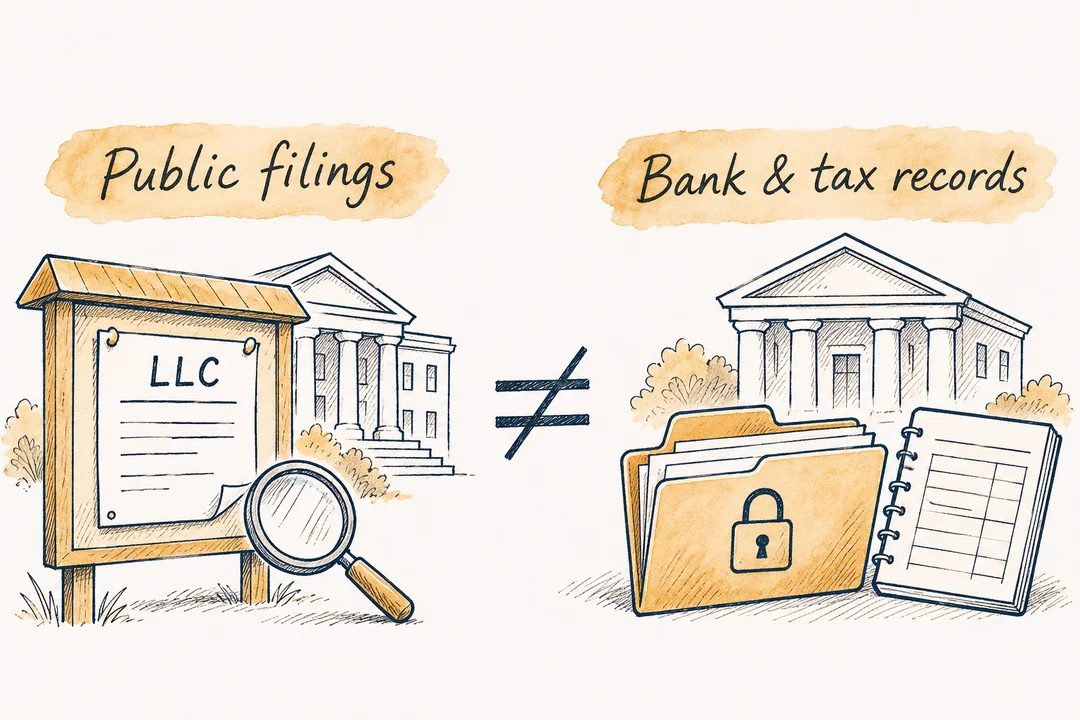
FinCEN’s customer due diligence guidance describes identity and beneficial-owner checks for covered financial institutions. Its federal BOI framework is a separate reporting system. The current exemption for US-created entities does not mean that banks stop identifying their legal-entity customers.
The location of an owner and the country where the company was formed are also different facts. A US LLC with a foreign owner is not automatically a foreign-country entity for every reporting rule. Check the exact definitions for the rule you are applying.
Look beyond the first document
Check the filings due after formation as well as the articles. California’s initial Statement of Information has different fields from LLC-1. Pennsylvania’s annual report asks for at least one governor. The later-filing column identifies additional public records to inspect; it does not classify tax documents as public.
Read any amendment, annual or biennial report, initial report and certificate request you plan to submit. Optional information can become part of the record if you choose to include it. A signature made in an ownership or management capacity can also disclose more than a filing prepared by another legitimately authorized person.
Organizer is not the same as owner
An organizer is the person who acts to form the entity. That person can be a member, but the roles are not automatically the same. Several state forms make the distinction explicit. A “no membership roster” row therefore should not be read as “no individual is named anywhere.”
List real people in their actual roles and obtain any required consent before naming them. Our registered-agent guide explains that role.
An agent address does not replace every address field
A registered-agent service may supply a valid address for its own role, but a state can separately require a principal office, mailing address, residence address or contact location. The state decides which address types are acceptable in each field. A mailbox or virtual address that works for correspondence may not satisfy an office or agent requirement.
Read the actual instructions before substituting one address for another. Some jurisdictions have specific accommodations or protected-address programs; those should be checked on their own eligibility rules rather than treated as a general option for every founder.
Check the filings in Delaware, New Mexico, Wyoming and Nevada
Delaware, New Mexico and Wyoming are often discussed because their ordinary formation documents do not call for a membership roster in the same way that some other states’ filings do. That is a narrower fact than a guarantee of anonymity. Agent details, organizer/signature fields, addresses and later records still matter.
Nevada illustrates why a state’s marketing reputation is not enough. Its articles identify initial managers or initial members, and its initial/annual list is an additional record. A state can be attractive for one business reason while still requiring named management information.
Choosing another state also does not remove qualification or tax obligations where the business actually operates. If you need to register in your operating state, review that second state’s public records as well.
Method, scope and sources
The comparison is limited to ordinary domestic LLC formation records. Professional, agricultural, series, regulated and other special entities can have additional disclosures. Each row links to the form, filing instructions or statutory text used for its description. Where a publicly accessible statutory reproduction is used, the row identifies that basis; it is not represented as a separate government confirmation.
The categories describe the reviewed document’s fields, not a privacy score. Forms, laws and filing portals can change. For a sensitive address or ownership situation, have a qualified professional review the exact filings and the relevant protections before you submit them.
Read filing fees, recurring reports and the appropriate state guide alongside this table. Compare the records you would file in every state where your business needs registration.
