

If you live outside the United States, start with any state where your business will operate. A US office, employees, inventory or other operating presence can create registration and tax obligations there, even if you form the LLC elsewhere.
If there is no particular US operating state, New Mexico and Wyoming are practical options to compare for administrative cost and maintenance. Delaware belongs on the list when there is a specific commercial or legal reason to use it; its reputation does not make it the lowest-cost choice for every small LLC. The choice depends on your operations, ownership and tax position.
“Living abroad,” citizenship and US tax residency are different facts. A foreign passport does not by itself establish nonresident status for tax purposes, and a US citizen living abroad may still have US tax obligations. Determine the owner’s tax position separately from the LLC’s state of formation.
List the business’s US and overseas activities
The Small Business Administration’s registration guidance explains that operating in more than one state can require formation in one place and foreign qualification in another. In this context, a “foreign LLC” can simply be a company formed in a different US state. That label is different from a company formed under the law of a foreign country.
Before choosing a state, write down where these things will be located:
- People doing the work, including employees and anyone running a regular office.
- Warehouses, inventory, equipment and other business property.
- Stores, premises or services performed in person.
- Customers and sales that may create tax obligations even without an office.
- The owner’s home-country management, tax and reporting connections.
A purely online business still has a real operating model. Selling a digital service from abroad is different from keeping stock in a US fulfillment center. A virtual address or agent service does not answer every registration or tax question about those activities.
A practical state shortlist
The figures below are government filing items from our state guides. They exclude agent subscriptions, advice, licenses and taxes that depend on the business. Follow the state link for the complete notes and official fee sources.
| State | Formation | Recurring state item | When to consider it |
|---|---|---|---|
 New Mexico | $50$50 statutory filing fee under section 53-19-63(A). Payment convenience charges, optional services and later amendments are separate. | $0Secretary of State periodic report. Not required for an ordinary LLC. The current LLC Act contains no annual or biennial report obligation, and section 53-19-63 lists no recurring report filing fee. This statutory review concerns the entity filing only; keep agent and address records current and check tax and license requirements separately. | Compare New Mexico for a low formation fee and no ordinary periodic LLC report, if your business has no US operating state that needs priority. |
 Wyoming | $100The published formation filing charge is $100. Online payment or service charges may be separate. | $60Annual Report / License Tax. Annually; confirm the entity’s anniversary deadline. $60 is the minimum. The amount is the greater of $60 or $0.0002 per dollar of assets located and employed in Wyoming. | Compare Wyoming’s formation fee with its annual report and license tax. The tax has a minimum and can increase with Wyoming assets. |
 Delaware | $110The August 2026 fee schedule lists $110 for domestic LLC formation. Certified copies and expedited service are separate optional charges. | $400Annual LLC tax. Annually, due June 1. The $400 rate applies from the 2026 tax year; tax for 2026 is due June 1, 2027. Older state FAQ pages may still show $300. LLCs do not file the corporation annual report. | Consider Delaware when an adviser, counterparty or ownership arrangement gives you a specific reason to use it. Include its annual LLC tax in your budget. |
New Mexico: a simple state filing profile
New Mexico has a low statutory formation fee and no ordinary annual or biennial Secretary of State report under its current LLC Act. That reduces state filing work. Agent service, licenses and tax obligations remain separate costs.
You still need an eligible registered office and agent, accurate records and the filings required when relevant details change. An agent’s annual subscription can remain a recurring expense even when the state does not charge an annual LLC report fee. Check gross receipts, licensing and other tax questions for the actual business activity.
Wyoming: compare the recurring obligation
Wyoming’s annual report includes a license tax with a minimum and an asset-based calculation. Use the Wyoming guide to calculate the amount from assets located and used there.
A public formation filing that does not request a membership roster is also not a promise of complete anonymity. Filers, addresses and later records can disclose information, and banks and tax authorities have separate requirements. Use the privacy-by-state guide for that distinction.
Delaware: look for a specific reason
Delaware LLCs have a separate annual tax, even though they do not file the corporation annual report. That makes the ongoing cost important when comparing a small one-owner business with other options.
Ask what benefit you need from Delaware in your particular arrangement. If the real issue is future investors, first confirm whether those investors want an LLC at all. Choosing a familiar state name before deciding the appropriate entity and ownership structure can create later conversion work.
An actual operating state can outrank the shortlist
If you will run a Florida shop, maintain a Texas office or carry on business in California, a New Mexico or Wyoming filing does not replace the analysis for that operating state. You may need foreign qualification, local licenses, tax accounts and an agent arrangement there as well.
Include any second-state registration and its ongoing costs in your comparison. A virtual address does not remove those obligations.
Plan the LLC’s federal tax treatment and reporting
For federal income tax, a single-owner LLC is usually treated as part of its owner’s return, called a disregarded entity. An LLC with two or more owners is usually a partnership. Corporate tax elections can change that treatment. The IRS LLC overview explains the defaults and elections.
A foreign-owned US LLC taxed as a disregarded entity may need to file Form 5472 when it has reportable transactions with its owner or another related party. Contributions, distributions and formation-related transactions can count, even when there is no profit. The Form 5472 instructions explain the reporting test and the pro forma Form 1120 that accompanies the form.
Taxable US income is another question. The IRS’s effectively connected income guidance discusses income connected with a US trade or business. The result can depend on activity, sourcing, ownership and an applicable treaty. A state with no individual income tax does not settle that federal analysis or the tax treatment in the owner’s home country.
Do not assume an S-corporation election is available to every foreign owner. The IRS lists a restriction on nonresident-alien shareholders among its S-corporation eligibility requirements.
An EIN and a bank account are separate steps
The IRS does not charge for an EIN. However, its online application has eligibility conditions, including a US or US-territory principal place of business and the responsible party’s SSN or ITIN. The IRS EIN guidance explains other application methods when the online route does not fit. The ability to form an LLC is not the same as eligibility to use the online EIN tool.
Banking providers decide what documentation and customers they accept. Ask the provider about the actual ownership, residence, business activity, address and document requirements before paying for a formation package built around a promised bank account. Approval by the state does not oblige a bank or payment provider to approve you.
FinCEN’s customer due diligence guidance describes identity and beneficial-owner checks for covered financial institutions. A privacy-oriented public filing does not remove those checks.
Check federal and state ownership reporting
Under FinCEN’s current federal BOI framework, entities created in the US are exempt, while certain foreign-country entities registered to do business in the US can remain subject to reporting. A US LLC owned by a person abroad is not automatically a foreign-country entity merely because of its owner. Use FinCEN’s current BOI page, and check any separate state requirement that applies to the entity.
A decision checklist before paying
- Identify the company’s real US operating footprint and likely foreign-qualification needs.
- Confirm the owner’s tax-residency position and the intended federal tax classification.
- Compare formation charges, recurring state items, agent fees and likely professional help.
- Check public-record fields and whether the proposed addresses meet the rules.
- Confirm the EIN application method and realistic banking requirements.
- Arrange a calendar for US information returns, state tasks and home-country obligations.
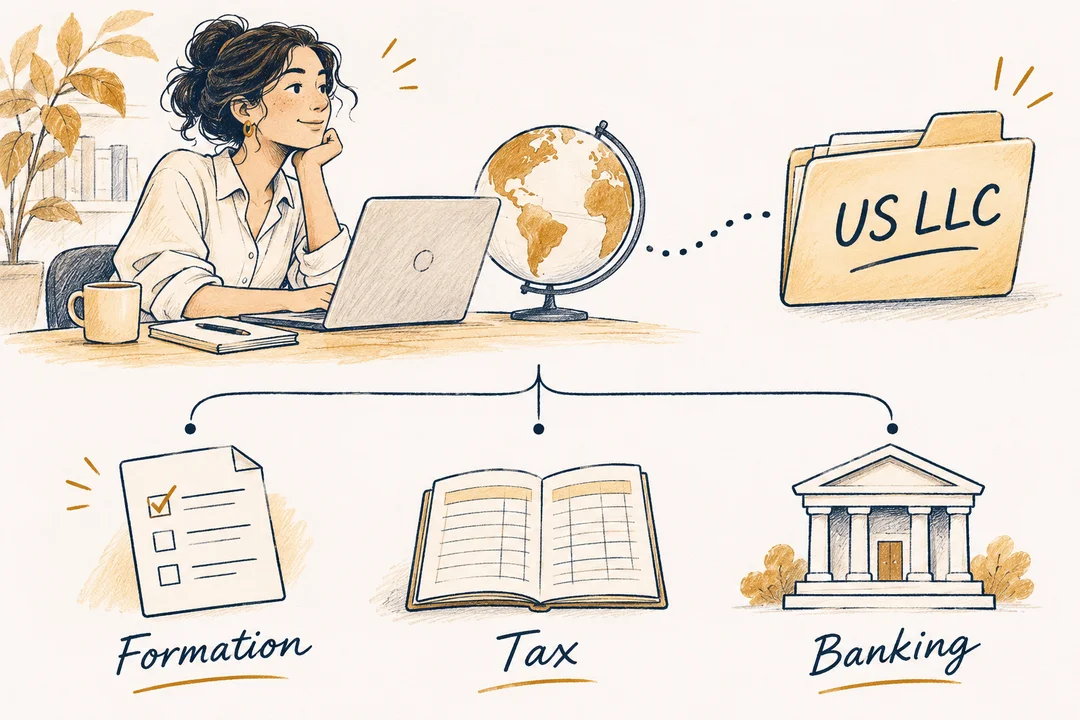
The state choice should follow that plan. Use the filing-fee table, recurring-fee list, processing-time list and sales-tax overview as separate reference tools. For questions tied to your facts or two countries’ rules, get advice from a qualified professional familiar with the situation.
