

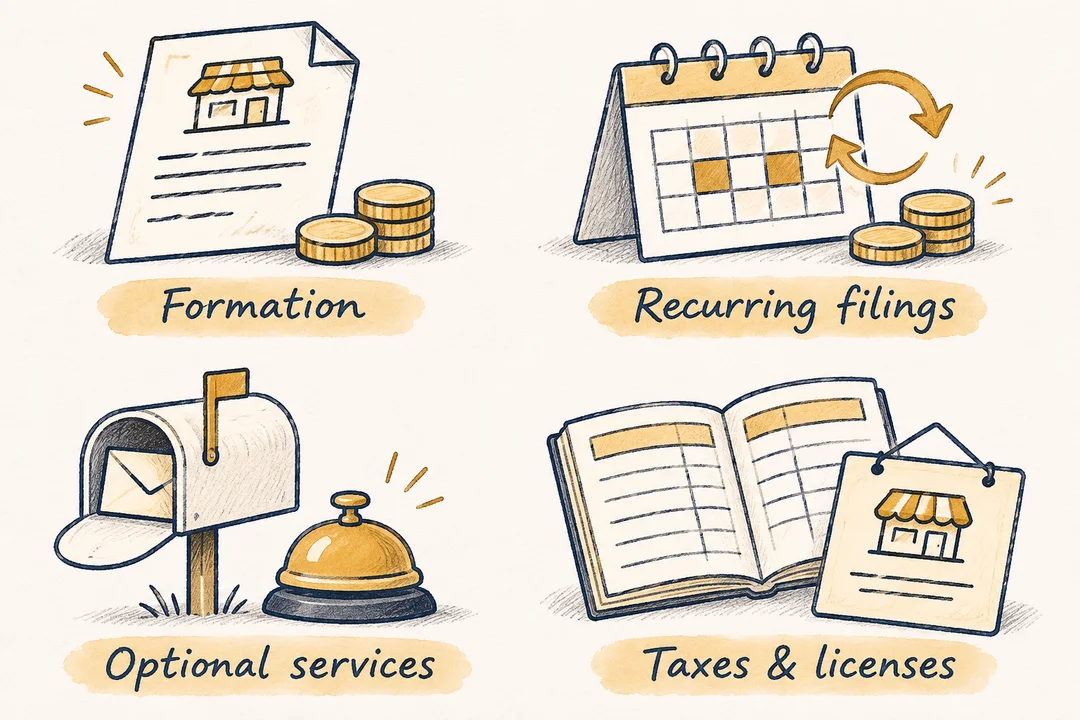
Your LLC budget starts with the state’s filing fee. Add any required initial filings, licenses, taxes and private services you choose, then budget for recurring charges. The total depends on your state and business activity.
Find formation fees and recurring filing charges in the state comparison table. Open your state’s guide for required extras and official sources; the table is not a complete first-year quote.
Separate one-time and recurring costs
Start with two lists: money needed to form the entity and money needed to keep it operating. A name reservation, formation filing or publication may be an initial item. An annual report, business-license renewal, agent service or tax can return later.
The filing method matters as well. Some states charge different amounts for online and paper submissions, and a portal may add a handling or payment charge. Expedited review is usually a separate selection rather than part of every formation.
| Cost category | What to check |
|---|---|
| Formation filing | The official document, filing method and total charged by the state |
| Required initial follow-up | Initial reports, publication, licenses or other state-specific items |
| Registered agent or office | Eligibility to provide your own arrangement and any private-service renewal |
| EIN | A direct IRS application is free |
| Operating agreement help | The complexity of the ownership arrangements and any professional service used |
| Recurring filings | The amount, frequency and first due date |
| Taxes and licenses | Requirements based on the business and its activities |
What Florida and California filing fees cover
Florida’s official LLC fee schedule separates a $100 filing charge and a required $25 registered-agent designation charge, for a $125 initial total. That state designation charge is different from hiring a private registered-agent service.
California’s domestic LLC forms page lists a $70 Articles of Organization filing and a separate $20 Statement of Information. Its tax agency also describes an annual LLC tax and an income-based fee for relevant classifications. Review the FTB’s filing information for the rules and exceptions.
An EIN is free from the IRS
The IRS does not charge for an EIN. A private provider may sell assistance, but that assistance is separate from the government application.
The online tool has eligibility requirements. A person who cannot use it may need another IRS application method; that does not create a government application fee. Follow the IRS’s current instructions and form the LLC with the state before applying for its EIN.
Check service prices and renewal charges
A package price may include some tasks and exclude others. Before paying, identify the state fee, the provider’s fee, recurring charges, optional additions and cancellation terms. Check whether a low introductory price changes at renewal.
A registered-agent service and a virtual mailbox are not automatically interchangeable. Likewise, purchasing a formation package does not by itself resolve licensing, tax or operating-agreement questions.
Our service reviews identify the providers with which we have affiliate relationships. The affiliate disclosure explains how commissions work.
Build a first-year and ongoing budget
For each cost, note who you pay, what it covers, whether it repeats and when it is due. Mark which charges are required and which services are optional.
Allow room for the business’s actual operations: banking, bookkeeping, insurance, licenses and qualified advice when needed. If the LLC must qualify in another state, add that jurisdiction’s registration and maintenance requirements. The SBA launch guidance explains the broader registration and licensing context.
Save the source links and check the charge again before submitting. Use the checklist to connect the budget with the tasks, and keep a recurring calendar after approval.
Use the state filing-fee table and annual-report fee list for state-by-state figures.
