

Find general statewide sales-tax rates in the table below. The tax on a particular sale also depends on its location, local rates, the product or service, exemptions and who must collect it.
The table uses the July 1, 2026 general-rate comparison snapshot, with precise rate notes from selected state authorities. It does not calculate tax for a specific address or transaction. California, Utah and Virginia figures include uniform local components in the commonly published statewide starting rate; Arizona, Hawaii and New Mexico use business-tax systems that need separate attention.
Compare every state
| State | General base rate | Local additions | Important distinction | Source |
|---|---|---|---|---|
 AlabamaAL | 4% | Local rates may apply | General rate for ordinary taxable sales; exemptions, special products and local rules can change the result. | Rate sourceTax agency |
 AlaskaAK | 0%No statewide general sales tax | Local rates may apply | No statewide general sales tax. Municipal sales taxes can still apply. | Rate sourceTax agency |
 ArizonaAZ | 5.6%Transaction privilege tax | Local rates may apply | Arizona uses a transaction privilege tax on taxable business activities. The general retail state rate is shown; local rates and other classifications can differ. | Rate sourceTax agency |
 ArkansasAR | 6.5% | Local rates may apply | General rate for ordinary taxable sales; exemptions, special products and local rules can change the result. | Rate sourceTax agency |
 CaliforniaCA | 7.25% | Local rates may apply | 7.25% is the statewide base including uniform local components. District taxes can raise the address-specific rate. | Rate sourceTax agency |
 ColoradoCO | 2.9% | Local rates may apply | General rate for ordinary taxable sales; exemptions, special products and local rules can change the result. | Rate sourceTax agency |
 ConnecticutCT | 6.35% | No general local add-on shown | General rate for ordinary taxable sales; exemptions, special products and local rules can change the result. | Rate sourceTax agency |
 DelawareDE | 0%No statewide general sales tax | No general local add-on shown | No general sales tax. Other business taxes, including gross-receipts obligations, are a separate question. | Rate source |
 District of ColumbiaDC | 6% | No general local add-on shown | The general rate is 6%; certain categories such as meals and lodging have separate rates. | Rate sourceTax agency |
 FloridaFL | 6% | Local rates may apply | General rate for ordinary taxable sales; exemptions, special products and local rules can change the result. | Rate sourceTax agency |
 GeorgiaGA | 4% | Local rates may apply | General rate for ordinary taxable sales; exemptions, special products and local rules can change the result. | Rate sourceTax agency |
 HawaiiHI | 4%General excise tax | Local rates may apply | Hawaii uses a general excise tax on business activity, not an identical retail-sales-tax system. County surcharges can apply. | Rate sourceTax agency |
 IdahoID | 6% | Local rates may apply | General rate for ordinary taxable sales; exemptions, special products and local rules can change the result. | Rate sourceTax agency |
 IllinoisIL | 6.25% | Local rates may apply | General rate for ordinary taxable sales; exemptions, special products and local rules can change the result. | Rate sourceTax agency |
 IndianaIN | 7% | No general local add-on shown | General rate for ordinary taxable sales; exemptions, special products and local rules can change the result. | Rate sourceTax agency |
 IowaIA | 6% | Local rates may apply | General rate for ordinary taxable sales; exemptions, special products and local rules can change the result. | Rate sourceTax agency |
 KansasKS | 6.5% | Local rates may apply | General rate for ordinary taxable sales; exemptions, special products and local rules can change the result. | Rate sourceTax agency |
 KentuckyKY | 6% | No general local add-on shown | General rate for ordinary taxable sales; exemptions, special products and local rules can change the result. | Rate sourceTax agency |
 LouisianaLA | 5% | Local rates may apply | The general state rate is 5%, effective from January 2025. The older 4.45% figure is not used. | Rate sourceTax agency |
 MaineME | 5.5% | No general local add-on shown | General rate for ordinary taxable sales; exemptions, special products and local rules can change the result. | Rate sourceTax agency |
 MarylandMD | 6% | No general local add-on shown | General rate for ordinary taxable sales; exemptions, special products and local rules can change the result. | Rate sourceTax agency |
 MassachusettsMA | 6.25% | No general local add-on shown | General rate for ordinary taxable sales; exemptions, special products and local rules can change the result. | Rate sourceTax agency |
 MichiganMI | 6% | No general local add-on shown | General rate for ordinary taxable sales; exemptions, special products and local rules can change the result. | Rate sourceTax agency |
 MinnesotaMN | 6.875% | Local rates may apply | The precise general state rate is 6.875%; a two-decimal summary may display 6.88%. | Rate sourceTax agency |
 MississippiMS | 7% | Local rates may apply | General rate for ordinary taxable sales; exemptions, special products and local rules can change the result. | Rate sourceTax agency |
 MissouriMO | 4.225% | Local rates may apply | The precise general state rate is 4.225%; a two-decimal summary may display 4.23%. | Rate sourceTax agency |
 MontanaMT | 0%No statewide general sales tax | No general local add-on shown | No general statewide sales tax. Special resort or other transaction taxes may still apply. | Rate sourceTax agency |
 NebraskaNE | 5.5% | Local rates may apply | General rate for ordinary taxable sales; exemptions, special products and local rules can change the result. | Rate sourceTax agency |
 NevadaNV | 6.85% | Local rates may apply | Use the published 6.85% statewide minimum as a starting point; county rates can be higher. | Rate sourceTax agency |
 New HampshireNH | 0%No statewide general sales tax | No general local add-on shown | No general sales tax. Meals, rooms and other specially taxed transactions are outside this general rate. | Rate sourceTax agency |
 New JerseyNJ | 6.625% | No general local add-on shown | The general rate is 6.625%. Certain qualifying transactions or locations have reduced-rate rules; this is not a general local add-on. | Rate sourceTax agency |
 New MexicoNM | 4.875%Gross receipts tax | Local rates may apply | The 4.875% state gross-receipts base is only one layer. County and municipal rates can add; the tax also reaches many services. | Rate sourceTax agency |
 New YorkNY | 4% | Local rates may apply | General rate for ordinary taxable sales; exemptions, special products and local rules can change the result. | Rate sourceTax agency |
 North CarolinaNC | 4.75% | Local rates may apply | General rate for ordinary taxable sales; exemptions, special products and local rules can change the result. | Rate sourceTax agency |
 North DakotaND | 5% | Local rates may apply | General rate for ordinary taxable sales; exemptions, special products and local rules can change the result. | Rate sourceTax agency |
 OhioOH | 5.75% | Local rates may apply | General rate for ordinary taxable sales; exemptions, special products and local rules can change the result. | Rate sourceTax agency |
 OklahomaOK | 4.5% | Local rates may apply | General rate for ordinary taxable sales; exemptions, special products and local rules can change the result. | Rate sourceTax agency |
 OregonOR | 0%No statewide general sales tax | No general local add-on shown | No general sales tax. Other business or transaction taxes are outside this comparison. | Rate sourceTax agency |
 PennsylvaniaPA | 6% | Local rates may apply | General rate for ordinary taxable sales; exemptions, special products and local rules can change the result. | Rate sourceTax agency |
 Rhode IslandRI | 7% | No general local add-on shown | General rate for ordinary taxable sales; exemptions, special products and local rules can change the result. | Rate sourceTax agency |
 South CarolinaSC | 6% | Local rates may apply | General rate for ordinary taxable sales; exemptions, special products and local rules can change the result. | Rate sourceTax agency |
 South DakotaSD | 4.2% | Local rates may apply | The general state rate is 4.2%. The tax base is broad and local rates may add; do not use an older 4.5% table. | Rate sourceTax agency |
 TennesseeTN | 7% | Local rates may apply | General rate for ordinary taxable sales; exemptions, special products and local rules can change the result. | Rate sourceTax agency |
 TexasTX | 6.25% | Local rates may apply | General rate for ordinary taxable sales; exemptions, special products and local rules can change the result. | Rate sourceTax agency |
 UtahUT | 6.1% | Local rates may apply | This comparison includes the 1.25% uniform local add-on in the 6.1% starting figure. Other local and product-specific rates vary. | Rate sourceTax agency |
 VermontVT | 6% | Local rates may apply | General rate for ordinary taxable sales; exemptions, special products and local rules can change the result. | Rate sourceTax agency |
 VirginiaVA | 5.3% | Local rates may apply | The 5.3% starting figure includes the 1% uniform local component. Additional regional/local rules can apply. | Rate sourceTax agency |
 WashingtonWA | 6.5% | Local rates may apply | General rate for ordinary taxable sales; exemptions, special products and local rules can change the result. | Rate sourceTax agency |
 West VirginiaWV | 6% | Local rates may apply | General rate for ordinary taxable sales; exemptions, special products and local rules can change the result. | Rate sourceTax agency |
 WisconsinWI | 5% | Local rates may apply | General rate for ordinary taxable sales; exemptions, special products and local rules can change the result. | Rate sourceTax agency |
 WyomingWY | 4% | Local rates may apply | General rate for ordinary taxable sales; exemptions, special products and local rules can change the result. | Rate sourceTax agency |
No states match those filters.
Three questions before applying a rate
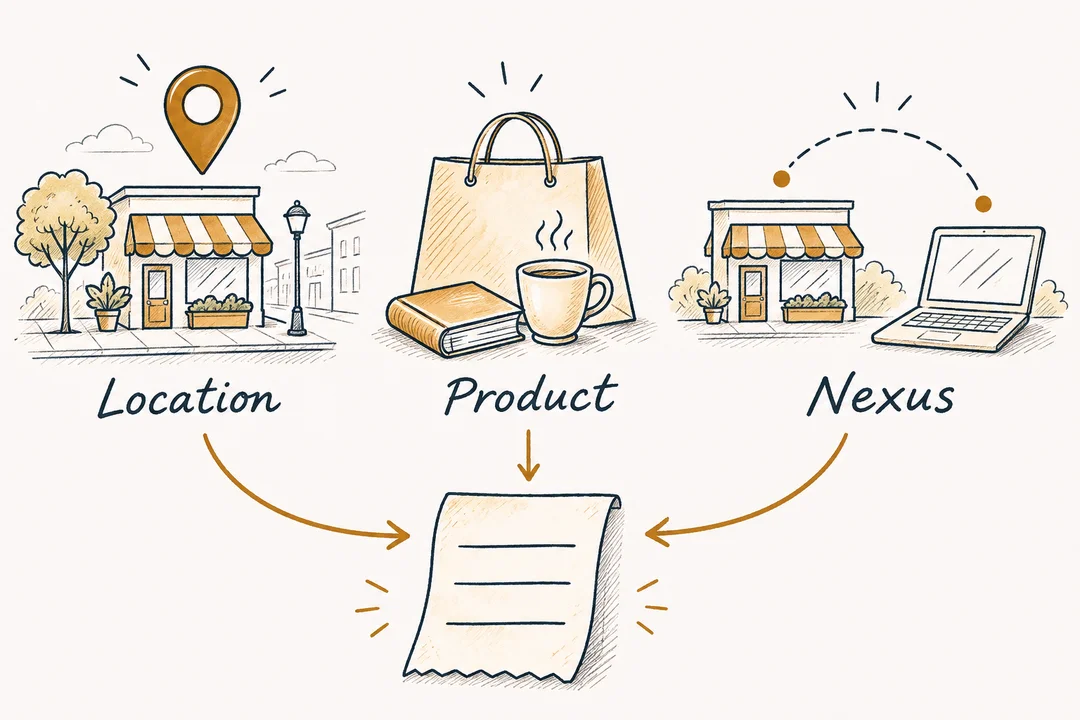
Before setting a rate, answer three questions:
- Which location’s tax rules apply to the sale?
- Is the product or service taxable there?
- Must you, the marketplace or another party collect and report the tax?
The LLC’s formation address alone does not answer these questions.
State and local components
A statewide general rate can be only part of a combined rate. Cities, counties and other authorized districts may add amounts. In some summaries, a mandatory statewide local component is already included in the displayed base; adding it again would overstate the result.
For example, California’s rate guidance identifies the 7.25% statewide base and directs users to address-specific tools for district taxes. New York’s guidance distinguishes its state component, local rates and the MCTD component where applicable. Use an official location lookup when applying a rate to a sale.
What you sell can change the treatment
Groceries, prepared food, clothing, prescription drugs, software, digital products, professional services and vehicles do not all follow one uniform rule across states. A general rate does not tell you whether a particular sale is taxable or whether an exemption certificate is appropriate.
Special rates and exclusions are intentionally outside the table’s single general-rate column. This prevents a grocery exception or hotel tax from being confused with the ordinary statewide starting rate. Review the relevant state’s product or service guidance before setting up collection.
Nexus: your business connection to a state
Nexus is a connection that can create tax obligations in a state. It can come from physical activity or property, or from reaching that state’s remote-sales threshold. A marketplace may collect tax on sales made through its platform, but you may still have registration, return or direct-sale obligations.
For each state where you sell, check its rules for your product, sales channel and business activity. Use the state agency’s registration guidance and official rate lookup before collecting tax.
Five states without a general statewide sales tax
Alaska, Delaware, Montana, New Hampshire and Oregon do not impose a general statewide sales tax in the comparison. That statement has limits:
- Alaska municipalities can impose sales taxes even though the statewide general rate is zero.
- Other taxes can exist without a general sales tax, including business taxes and taxes on particular products or activities.
- Special resort, meals, rooms or similar regimes are not replaced by the zero in a general-rate table.
- A business formed in one of these states can still have obligations connected with sales or activities in another state.
A zero in the table applies only to the general statewide sales tax.
Arizona, Hawaii and New Mexico use different systems
Arizona’s transaction privilege tax applies to taxable business activities; its official rate lookup helps identify the jurisdiction and rate. Hawaii’s general excise tax is imposed on business activity and is not simply identical to a consumer retail sales tax. New Mexico’s gross receipts tax also reaches a broad range of receipts and services. A rate comparison can show their general starting figures, but the tax base, pass-through treatment and exemptions still need their own analysis.
New Mexico’s local-option guidance describes the state base plus county and municipal layers. Use the applicable location and business rules instead of assuming that the 4.875% state component is the final amount for every sale.
Why forming an LLC elsewhere does not settle sales tax
A seller’s LLC filing creates the entity under a particular state’s law. Sales-tax obligations follow the applicable tax rules for the seller and transactions. Moving the formation paperwork to a state with a lower general rate does not, by itself, change where goods are delivered, inventory is held, work is done or customers are served.
Consider the entity choice and the tax setup as separate tasks. The guide for US residents starts with the real operating footprint, and the guide for founders abroad explains why a US entity, its owners and its tax obligations are separate questions.
Method and sources
The general-rate snapshot comes from the Tax Foundation’s midyear 2026 state comparison. We retain its distinction between statewide and local components and do not use its average combined rates as checkout rates. More precise figures are shown where state materials specify them: for example, 6.625% rather than a rounded 6.63%, 6.875% rather than 6.88%, and 4.225% rather than 4.23%.
The state materials reviewed for this table give these rates: Louisiana’s general rate is 5%, South Dakota’s is 4.2%, and New Mexico’s state gross-receipts base is 4.875%. The row’s rate source is separate from any supplementary agency link. Official agency links are drawn from the Federation of Tax Administrators’ public directory; the SBA’s revenue-agency lookup is another starting point.
The source-review date does not make this a live tax-rate service. Recheck official rates and taxability for the transaction date and location before charging or filing tax. For entity costs instead, see LLC filing fees and annual reports and recurring charges.
