

Key takeaways
- State websiteUtah Division of Corporations and Commercial Code
- State filing fee$59
- TimeOnline: Usually immediate; some filings need manual reviewBy mail: Paper-form/manual review: allow 5–7 business daysAgency timing
- Filing methodOnline and paper
- Annual report$18 · Every year by the last day of the anniversary month
What you will pay in Utah
The only required state charge to form the LLC is the $59 Certificate of Organization fee. After that, the LLC pays $18 each year for its annual report, which Utah also calls a renewal. The Division of Corporations and Commercial Code fee schedule says all processing fees are nonrefundable. Check the amount in your shopping cart before you pay.
| Item | Amount | When | Required? |
|---|---|---|---|
| Certificate of Organization | $59 | When you file | Yes |
| Registered agent | Set by the agent you choose, or nothing if you serve yourself | Before you file | Yes, an agent is required |
| Annual report (renewal) | $18, which includes a $5 surcharge for the state's single sign-on portal | Each year by the last day of the anniversary month | Yes |
| Late renewal fee | $10 | Only if the renewal is filed 31 to 60 days after the due date | No |
| Reinstatement | $59 | Only if the state dissolves the LLC | No |
| Name reservation | $22 | Only if you want to hold a name before you file | No |
| Registered agent change by form or online | $13 | When the agent changes outside the renewal | No |
| Amendment to the Certificate of Organization | $37 | When you change the name or another statement in the certificate | No |
| Expedited processing | $75 per filing | Only if you ask for faster processing | No |
| Certificate of Existence | $12 short form, $20 long form | When a bank or another state asks for proof | No |
| Assumed name (DBA) | $18 | Only if the LLC uses a different trade name | No |
| Voluntary dissolution or termination | No charge | When you close the LLC | No |
Step 1: Choose and check the name
Pick a name that has the right ending and is distinguishable from names already on the Division's records, then check it with the free Name Availability search. A reservation is optional and costs $22.
Name rules
- Ending: under Utah Code Section 16-1a-303, the name must contain limited liability company or limited company, or the abbreviation L.L.C., LLC, L.C. or LC. Limited may be shortened to Ltd. and company to Co.
- Words you cannot use: association, corporation, decentralized autonomous organization, incorporated, partnership, limited partnership or L.P., or words of similar meaning.
- Restricted words: Olympic, Olympiad and Citius Altius Fortius need written consent from the United States Olympic Committee. Bank, banking, savings bank, escrow and related words need consent from the Department of Financial Institutions.
- No suggestion that the business is a state agency, unless it is authorized to use such a name.
- The name must be in English or written in letters of the English alphabet.
What makes a name distinguishable
Under Section 16-1a-302, a name is distinguishable if it has one or more different words, letters or numerals from other names in the Division's records. These differences do not count: entity endings such as LLC, Inc. or Co.; the words the, and, a or plus; punctuation, spacing or special characters; capitalization; and, for entities formed on or after May 4, 1998, abbreviations and singular or plural forms. The Division's Business Name Conventions and Policies page gives examples: Diana's Creations and Diana's Delights are distinguishable, but The Book Store and Book Store are not.
If the name is not distinguishable, the Division's policy page says you can still use it if the other business gives written consent and agrees to change its name, or if you attach a certified court judgment that establishes your right to the name.
Search the name
- Open the Business Registration System. You do not need to log in to search.
- Select Name Availability and type the name you want.
- Also select Search Business Entity Records to see registered businesses with similar names.
- Compare the results with the rules above before you file.
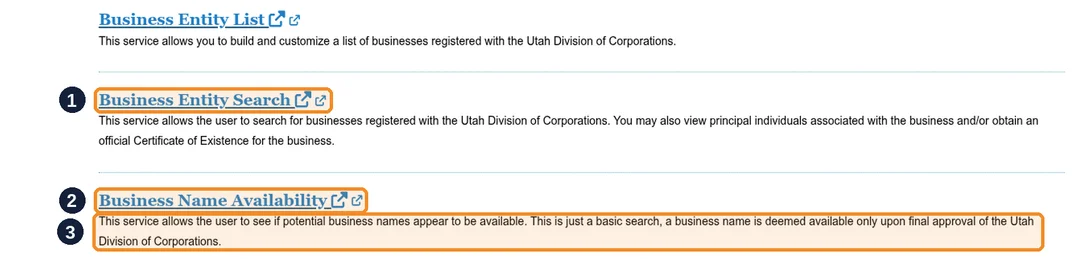
The search is a basic check. The Division says a name is final only when it approves the business filing, and that its search does not show names that are filed but not yet processed or businesses that use a name without registering it.
Reserving the name
A reservation is not required. It holds a name for 120 days for $22. To reserve, log in to the Business Registration System, select Other from the menu on the left, and choose the domestic name reservation. The Division says not to file a reservation if your formation documents are ready, and not to file one at the same time as the Certificate of Organization.
Step 2: Appoint a registered agent
Choose the registered agent before you file, because item 3 of the Certificate of Organization asks for one. The agent receives legal papers, such as a lawsuit notice, for the LLC. The Division also sends all of its correspondence to the agent, including the yearly renewal notice.
| Item | Requirement |
|---|---|
| Who can serve | An individual, a business entity, or a Commercial Registered Agent |
| Address | A Utah street address. A PO box can be listed only after the street address |
| Commercial agent | Give the agent's name only. The Division already has the address on file |
| Other agent | Give the name and the Utah street address |
| Consent | Under Section 16-1a-404, naming the agent affirms that the agent consents to serve |
A Commercial Registered Agent is a person or business that registers with the Division as an agent for several entities. You do not have to register as one to serve as the agent for your own LLC. The Division's online instructions say you can add yourself as the registered agent when you file. Published guides say you should be a Utah resident with a physical Utah address and be available there during business hours.
The agent's name and address become public. If you do not live in Utah, or you do not want your home address on the record, hire a commercial agent. The Commercial Registered Agent page links to the Division's agent database.
Changing the agent later
Change the agent online with File On An Existing Business, or with the Limited Liability Company Registration Information Change Form, for $13. You can also change the agent during the annual renewal at no added charge. If the LLC has no registered agent for 60 consecutive days, Section 16-1a-602 lets the Division start an administrative dissolution.
Step 3: File the Certificate of Organization
File the Certificate of Organization with the Utah Division of Corporations and Commercial Code for $59. The Division files new businesses through its online Business Registration System, and its login page says most filings are processed immediately.
Before you start
- A UtahID account. It is the state's single sign-on, and you create one at the first login.
- The LLC name with its ending, checked in Step 1.
- The principal office street address and mailing address. A PO box can follow the street address.
- The registered agent's name and, for an agent that is not commercial, a Utah street address.
- The organizer's name for the signature. The organizer is the person who signs and files.
- Optional: member and manager names, a duration, a business purpose and a delayed effective date.
- A credit card to pay online.
What the certificate asks for
The online filing asks for the same information as the paper Certificate of Organization. Utah Code Section 16-20-201 sets the required contents.
- 1. Name of Limited Liability Company
- Enter the full name with its ending, exactly as you want it on the record.
- 2. Principal office address
- A street address is required. A PO box can be listed after the street address. The Division's public-record note says you can use the business's physical address instead of a home address.
- 3. Registered agent
- Enter an individual, a business entity or a Commercial Registered Agent. For an agent that is not commercial, add a Utah street address.
- 4. Signature of organizer
- The organizer signs. Forms can be signed electronically, for example /s/John Smith.
- 5. Members and managers (optional)
- You can leave this blank. The Division says at least one manager, member or other governing person must be given in the annual report.
- 6. Duration (optional)
- Choose perpetual or give an end date.
- 7. Purpose (optional)
- Leave it blank or describe what the LLC does.
Under Section 16-1a-204, the filing takes effect when the Division files it, unless you give a later date. A later date cannot be more than 90 days after filing. If you give a date without a time, the LLC starts at 12:01 a.m. on that day.
File online
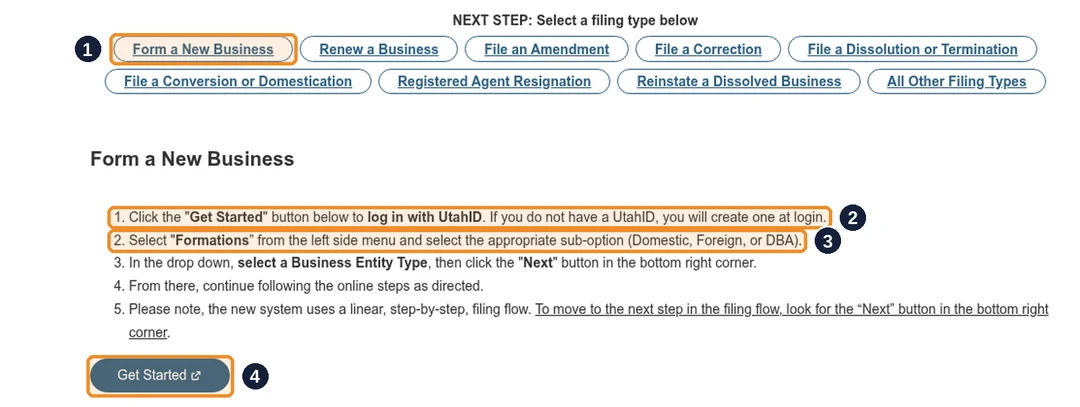
- Open the Business Registration System and log in with UtahID. If you do not have one, you create it at login.
- Select Formations from the left menu, then Domestic Formations.
- Select Domestic Limited Liability Company from the drop-down list and select Next. On the next page, make sure A Limited Liability Company is selected.
- Enter the name, the principal office and mailing addresses, and the registered agent. You can look up an existing agent or add a new one, including yourself.
- Enter the principal information for managers, members or organizers, and upload any added documents.
- Complete the signature section, which certifies the filing and adds electronic signatures.
- Review the filing, correct any errors and add it to the shopping cart.
- Open the shopping cart in the upper right and pay. You receive a confirmation, then an email when the filing is accepted.
The online system uses a linear flow. To move on, look for the Next button in the bottom right corner. If you leave before paying, the filing is not received: the Division says a filing counts as received only after the fee is paid.
Paper filing
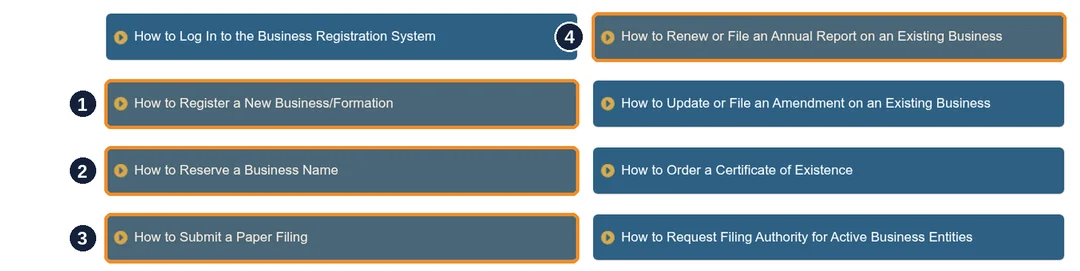
You can still use the paper Certificate of Organization. It must be typed or computer generated, except for signatures. Upload it with the Submit a Paper Filing option in the Business Registration System, or send it with a check or money order payable to the State of Utah to PO Box 146705, Salt Lake City, Utah 84114-6705. You can also file in person; the Commerce front desk at 160 East 300 South, 1st Floor, Salt Lake City, is open from 8:00 a.m. to 5:00 p.m. The Division cannot accept credit card details by email or mail.
| Item | Online | Paper |
|---|---|---|
| Fee | $59 by card | $59 by check or money order payable to the State of Utah |
| Processing | Most filings are processed immediately | Uploaded paper filings get manual review: allow 5 to 7 business days from receipt |
| Expedite | $75 per filing | $75 per filing |
| Copy of the filing | Sent by email once accepted | Send an extra copy and a return envelope with first-class postage if you want one |
The login page says manual review also applies to filings with attachments, filings that need Utah State Tax Commission review, and names that need a conflict check. The renewal page gives a different figure for its filings, 7 to 10 business days, so allow extra time if a bank or lender is waiting.
Filing Authority
Filing Authority is a security feature that lets only an administrator, and users the administrator invites, file on the LLC. It starts automatically for entities created after September 16, 2024, with the registering email as the administrator. If someone else files for you, their email becomes the administrator, and the administrator can grant privileges to others. Otherwise, becoming the administrator later takes a notarized affidavit emailed to corpucc@utah.gov.
What the filing makes public
Under the state's records law, the Division treats all registration information as public. The certificate shows the name, principal office, registered agent and organizer. Members and managers are optional on the certificate, but the annual report must list at least one, and anyone can view principals in the Business Entity Records search.
Step 4: After Utah accepts the filing
Once the Division accepts the certificate, the LLC has an entity number. Save the approval email and the number, because later filings and searches ask for it. Then work through these steps.
- Write an operating agreement. The Division describes the LLC agreement as the document that sets management, transfer of interests and the split of profits and losses. It is not filed with the state. Our operating agreement guide covers what to include.
- Get an EIN from the IRS. The Division says it does not issue EINs or keep records of them. The IRS instructions explain the application.
- Open a business bank account. Ask the bank which documents it needs, such as the approved certificate and the EIN letter.
- Register with the Utah State Tax Commission for taxes that apply. The Division's new-business tips say all employers need a state withholding number, and a sales tax number and a withholding number can both be applied for on Form TC-69, linked from the Tax Commission's tax account page.
- Get a local license if one applies. The Division's tips say the local license comes from the city or county where the business is based. Employers also contact the Department of Workforce Services about unemployment insurance and the Labor Commission about workers' compensation.
- Register a DBA for $18 if the LLC will trade under a different name.
- If you live and work outside Utah, check your home state's rules. Registering the LLC there means a second set of filings and fees. Our best state to form an LLC guide compares the options.
Step 5: File the annual report each year
Every Utah LLC files an annual report, also called a renewal, to stay active. It costs $18 and is due each year by the last day of the anniversary month, the month the LLC was formed.
| Item | Detail |
|---|---|
| Due date | The last day of the anniversary month each year, under Section 16-1a-212 |
| Earliest filing | Up to 60 days before the last day of the anniversary month |
| Notice | A postcard renewal notice goes to the registered agent. The Division FAQ says it is sent one year from the anniversary date |
| Contents | Name, registered agent, principal office street address, and at least one manager, member or other governing person |
| Fee | $18. No late fee in the first 30 days after the due date; $10 added in the next 30 days |
| Changes | You can update the address, purpose, registered agent and principals in the renewal at no added charge |
File the report online
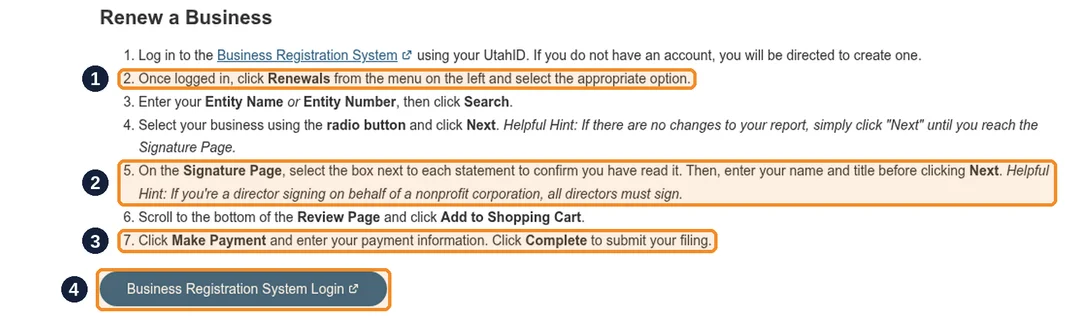
- Log in to the Business Registration System with UtahID.
- Select Renewals from the left menu, then Annual Report without changes or Annual Report with changes.
- Enter the entity name or entity number and select Search. Select the LLC with its radio button and select Next.
- If nothing changed, select Next until you reach the Signature Page. Otherwise update the sections you need.
- On the Signature Page, check the box next to each statement, enter your name and title, and select Next.
- On the Review Page, select Add to Shopping Cart, then Make Payment. Enter the payment details and select Complete.
The Division publishes step-by-step PDF guides for renewals without changes and with changes.
If the report is late
If the LLC does not renew on time, it has a 30-day grace period with no late fee. During the next 30 days, the delinquency period, the renewal costs $18 plus the $10 late fee. The Division mails a delinquency postcard to the registered agent, then an expiration postcard to the agent, the principal business address and one principal. Under Sections 16-1a-602 and 16-1a-603, the Division can start an administrative dissolution if the report is more than 60 days late, and the LLC then has 60 days after the notice to cure the problem.
The annual report is separate from state taxes. Income tax for an LLC is handled by the Utah State Tax Commission, whose pass-through entities page covers partnership and LLC tax.
Common questions
How much does it cost to form an LLC in Utah?
The state fee for the Certificate of Organization is $59, and the annual report costs $18 each year. A name reservation ($22) and expedited processing ($75) are optional. Our LLC filing fees by state guide compares other states.
Does Utah require an annual report?
Yes. Each LLC files an annual report, also called a renewal, for $18 by the last day of its anniversary month. Step 5 explains the steps and the late rules.
What is the Utah LLC formation form?
It is the Certificate of Organization, filed with the Utah Division of Corporations and Commercial Code for $59. You can file it online in the Business Registration System, and a paper form is also available.
How long does filing take?
The Division says most online filings are processed immediately. Paper filings and filings that need manual review take 5 to 7 business days from receipt, and an expedite costs $75. Our LLC processing times by state guide compares other states.
Do I need to live in Utah?
No. The certificate does not ask where members live. The registered agent needs a Utah street address, so an owner outside Utah hires an agent there. Our guide to the best states for non-US residents covers owners abroad.
Can I use my own address as the registered agent?
Yes, if it is a Utah street address. The Division's instructions say you can add yourself as the agent when you file. The address becomes public, and the Division's renewal notices go there.
Are the owners' names public?
Member and manager names are optional on the certificate, but the annual report must list at least one, and the Division treats all registration information as public. You can use the business address instead of a home address. Our LLC privacy by state guide compares other states.
Do I need to reserve the name?
No. A reservation is optional, holds a name for 120 days and costs $22. The Division says not to reserve a name if your certificate is ready to file.
Can I change the LLC's name later?
Yes. File an amendment to the Certificate of Organization online with File On An Existing Business. The amendment fee is $37. Check that the new name is distinguishable first.
Can I change the registered agent later?
Yes. Change it online, with the LLC Registration Information Change Form for $13, or during the annual renewal at no added charge.
Do I need an operating agreement, and does the state see it?
The Division describes the LLC agreement as the document that sets out how the company is managed and how profits and losses are split. It is not part of the Certificate of Organization and is not filed. Our operating agreement guide explains what it covers.
Do I need a Utah business license?
Utah's Division of Corporations registers the LLC; its tips say the local license is issued by the city or county where the business is based. Published guides say Utah has no general state business license. Register with the Tax Commission for taxes such as sales tax and withholding.
Can I get an EIN if I am not a US resident?
The EIN comes from the IRS, not Utah, so the IRS rules apply. The IRS instructions explain the options. The Division does not issue or keep EINs.
What is Filing Authority?
It is a security setting that lets only the administrator and invited users file on the LLC. For entities created after September 16, 2024, it starts automatically with the registering email as the administrator.
How do I dissolve the LLC?
File a Statement of Dissolution online with File On An Existing Business. There is no fee. Dissolution starts the winding up of the LLC; a Statement of Termination ends its existence. The Division suggests asking a CPA or attorney which to file.
How do I check that the LLC is active, and how do I prove it?
Search the LLC in Search Business Entity Records to see its status. A Certificate of Existence costs $12 for the short form or $20 for the long form, ordered under Copies and Certificates and sent by email. You cannot order one if the status is expired or dissolved.
Is Utah a good choice if I live and do business elsewhere?
It fits best when the business operates in Utah. An LLC formed in Utah but run from another state also registers there, which adds that state's fees and filings to Utah's. Our best state to form an LLC guide and state comparison cover the choice.
If you want help with the filing, compare LLC formation services. A service fee is separate from the state fee, and the official filing links above let you apply directly with the state. This guide is educational and is not legal or tax advice; see our disclaimer, and our affiliate disclosure for how we handle commissions.
Sources and links
Sources checked . Confirm the state’s current fees and instructions before filing.
- Utah Division of Corporations: Current Fee Schedule
- Utah Division of Corporations: Domestic Limited Liability Company
- Utah Division of Corporations: Online Registration Instructions
- Utah Business Registration System
- Utah Division of Corporations: Annual Report/Renewal Guide
- Utah Code 16-1a-212: Annual report for division
- Utah Code 16-1a-303: Name requirements
- Utah Code 16-1a-602: Grounds for administrative dissolution
- Utah Division of Corporations: Business Name Information
- Utah Certificate of Organization (paper form)
Research and walkthrough references
These references provide background and filing walkthroughs. Follow current state instructions if an older walkthrough differs.
See our editorial policy for the research process and contact page for correction information.