

Yes, a non-US resident can open a Mercury business account for a US LLC, and no SSN or ITIN is needed. You need a passport, your state formation document and your EIN letter. Three conditions decide the result: you must not live in one of the 48 countries Mercury excludes, your company needs a real (not virtual) place of business, and you must be able to show a connection to the US.
Mercury is a financial technology company, not a bank. Choice Financial Group and Column N.A. hold the deposits. The base plan costs $0 a month, with free ACH transfers, domestic wires and international wires sent in US dollars. We checked Mercury’s help center, pricing page and legal terms on November 12, 2026. We did not open an account.

Accepts US LLCs owned by non-US residents, unless the owner lives in one of 48 excluded countries or sanctioned regions.
- Accepts non-US owners
- Yes, by country of residence. 48 countries plus sanctioned regions are excluded.
- SSN or ITIN
- Not required. A passport is accepted.
- US address
- Legal address must be a US physical address, such as the one on your formation document. Your place of business can be abroad.
- Monthly fee
- $0 base plan. Plus is $35/month, or $29.90/month billed yearly.
- Domestic transfers
- $0 for ACH and domestic wires.
- International wires
- $0 in USD. 1% fee to send in another currency.
- Cards
- Debit cards and the IO card (1.5% cashback). 3% fee on card spend in other currencies.
- Deposits held at
- Choice Financial Group and Column N.A. Up to $5M FDIC coverage through an opt-in sweep.
Who Mercury accepts
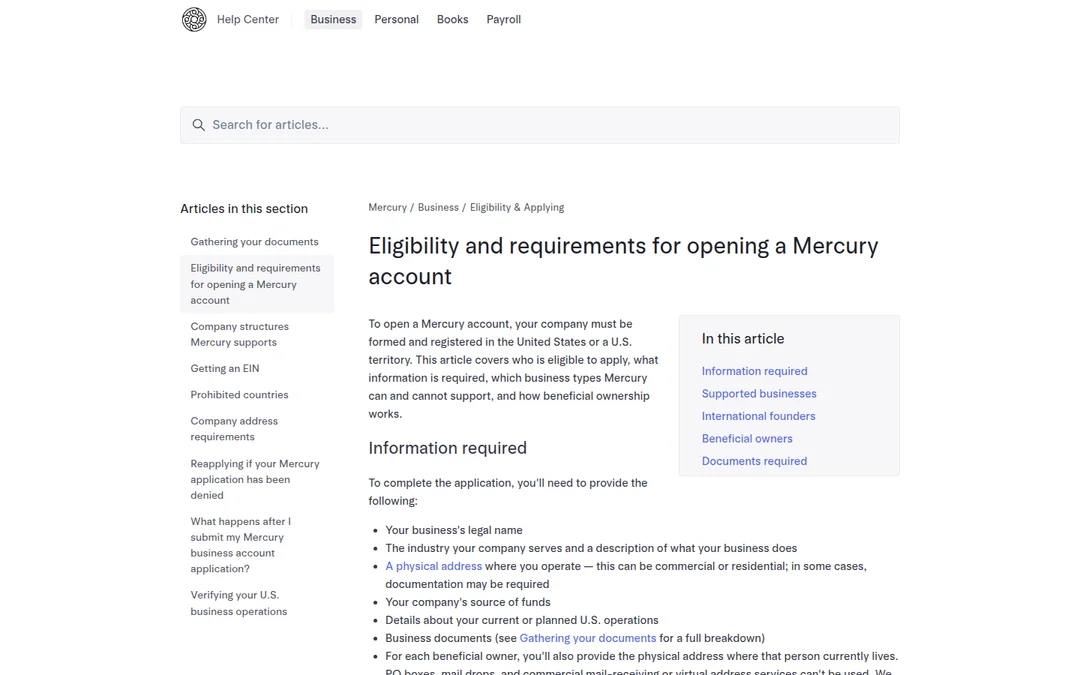
Mercury opens accounts for companies formed in the US or a US territory. You do not need US citizenship or US residency. The eligibility article lists LLCs, corporations and other US entities.
Countries Mercury does not support
Mercury refuses founders who live in, or businesses that operate in, 48 listed countries. Cuba, Iran, North Korea and the Russian-occupied regions of Ukraine are also excluded under sanctions. The test is where you live, not your passport. A citizen of a listed country who lives elsewhere may still be accepted after review.
The list includes Bangladesh, Indonesia, Nigeria, Pakistan, the Philippines, Ukraine, Russia and Vietnam. It also includes two EU members: Croatia and Latvia. India, Turkey, the United Kingdom and most of the EU are not on the list as of November 12, 2026. Read the current prohibited-countries list before you apply, because Mercury changes it.
Older forum posts say founders in Vietnam were accepted. The official list now names Vietnam. Use the official list, not older anecdotes.
Address rules
Mercury collects three addresses. Each has a different rule:
| Address | What Mercury accepts |
|---|---|
| Legal address | A physical US address, such as the address on your formation document. No P.O. box. |
| Physical address | Where you actually work. A home address or a verifiable address abroad is accepted. Registered agent, virtual, mail-center and P.O. box addresses are not. |
| Each owner’s home address | Where the owner lives now. Mail drops and virtual addresses are not accepted. |
If your legal address belongs to a registered agent, Mercury may ask you to prove your physical address. Accepted proof includes a lease, a utility bill or a bank statement from the last 90 days. The document must show the company or owner name and the full address. See the address requirements.
The US-operations test
Your business must have existing or planned operations in the US. If no owner lives in the US, holds a US ID or has a US workplace, Mercury may ask for proof. It can ask during the application or by email after approval.
Mercury lists these documents as proof. Each must match activity in your Mercury account:
- a record of a sale to a US customer (a screenshot works)
- an invoice or contract with a US customer, partner or supplier
- a signed SAFE or investment agreement
- employment or payroll records for a US-based employee
- a lease for a US office or coworking space (not a registered agent, virtual or mailbox address)
- a recent utility bill or the company’s latest federal tax return
Mercury says that an account without US operations “may be locked or eventually closed.” Plan your proof before you apply. A US payment processor, US clients or US suppliers usually give you the first documents. See verifying US operations.
Businesses Mercury does not support
Mercury does not support money services businesses, crypto exchanges, adult businesses, cannabis, internet gambling or trusts. Your account can hold US dollars only. You can send money to a third-party crypto exchange, but Mercury does not hold crypto.
What you need to apply
Prepare these documents before you start:
- Formation document filed with the state, such as Articles of Organization or a Certificate of Formation.
- EIN proof: IRS notice CP 575, letter 147C, or an SS-4 returned by the IRS. Our after-formation checklist covers the EIN step if you do not have one yet.
- Passport for each owner with 25% or more, and for one person with control of the company.
- Home address for each of those people.
- A description of your business, your source of funds and your current or planned US activity.
Mercury does not run a credit check. An SSN, if you have one, is used only to confirm identity.
How to apply
- Open the application on mercury.com. Mercury says the form takes about 10 minutes.
- Enter the company’s legal name, industry, legal address and physical address.
- Describe what the company does and how it will use the account. Name your US customers, suppliers or payment platforms.
- List every owner with 25% or more and one control person. Add each person’s home address.
- Upload the formation document, the EIN document and a passport for each listed person.
- Answer any follow-up email marked [Action Required]. An unanswered request is one of the closure reasons Mercury lists.
Mercury does not publish a review time. If Mercury denies your application, you can apply again with new information, but Mercury does not explain the reason for a denial.
Fees and plans
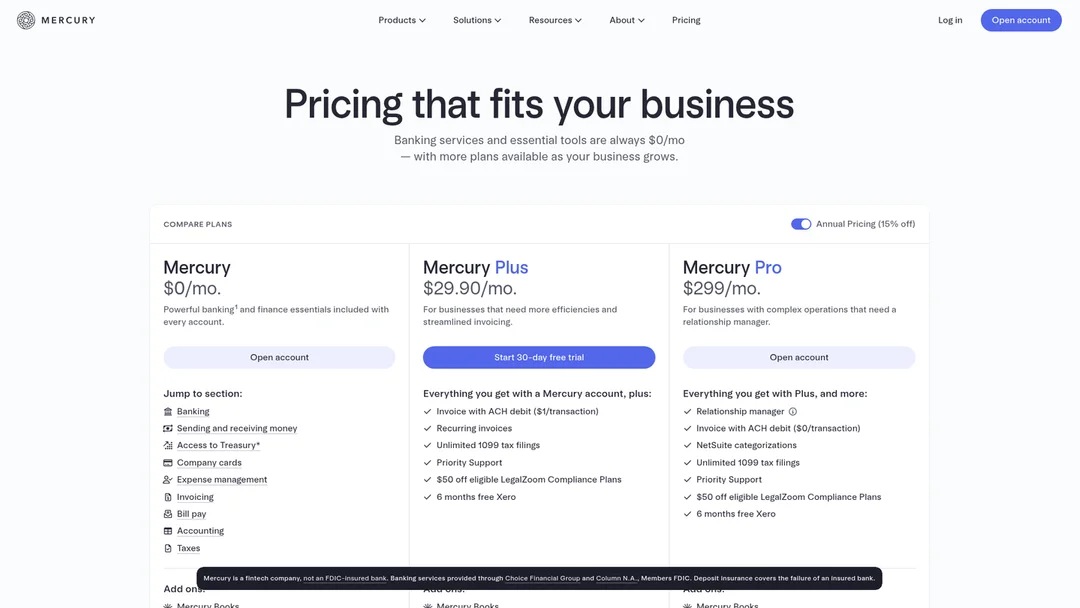
Banking features are free on every plan. Paid plans add invoicing, bill pay and support tools.
| Plan | Price | What changes |
|---|---|---|
| Mercury | $0/month | Accounts, cards, ACH, domestic and USD international wires, basic invoicing and bill pay. No minimum balance. |
| Mercury Plus | $35/month, or $29.90/month billed yearly | Recurring invoices, ACH debit on invoices ($1 each), unlimited 1099 filings and priority support. 30-day free trial. |
| Mercury Pro | $299/month billed yearly | Everything in Plus, a relationship manager and $0 ACH debit on invoices. |
The Plus trial changes to a paid monthly plan when it ends, unless you cancel. Mercury takes plan fees from your account balance. Some US states add sales tax to the fee based on your legal address. See Mercury pricing.
Sending and receiving money
Mercury is a US dollar account. It does not hold euros, pounds or other currencies.
- ACH and domestic wires: $0 on every plan.
- International wires in USD: $0.
- International wires in another currency: Mercury converts at the mid-market rate and adds a 1% fee. It supports more than 40 currencies.
- Receiving another currency: Mercury converts the payment to US dollars. For accounts at Choice Financial Group, intermediary banks convert it, usually with a 2–3% markup. Accounts at Column N.A. convert at the mid-market rate.
- Real-time payments: only for accounts held at Column N.A.
If clients pay you in euros or pounds, Mercury’s incoming conversion can cost more than a multi-currency provider. Compare it with Wise Business or Airwallex, which hold local currency balances.
Payment platforms and accounting
You can use Mercury as the payout account for Stripe, Shopify and Amazon. It connects to QuickBooks, Xero and NetSuite. These links matter for the US-operations test, because payouts from US platforms create a record of US activity.
Cards
Every account gets debit cards. Physical and virtual cards have country limits:
- Mercury does not issue any card to residents of 32 listed countries, including Nigeria, Ukraine and Vietnam.
- Mercury can issue virtual cards but cannot mail physical cards to some countries, including China, India, Indonesia and Morocco.
- Card mail to the Gulf states, Israel and the UAE is paused. Virtual cards work there.
The IO card is a charge card with 1.5% cashback. Mercury bases the limit on your cash balance, not your credit history. Introductory limits are usually up to $5,000. Higher limits and monthly payment need $15,000 in deposits. Card spending in a currency other than US dollars has a 3% fee.
Interest and Treasury
Mercury Treasury invests cash in a sample portfolio that mixes a money market fund (MRGXX), a bond fund (MCRYX) that is not a money market fund and can lose value, and a ladder of US Treasury bills. Mercury showed a yield of up to 4.21% on November 12, 2026, based on that sample portfolio, and charges an annual fee of 0.15% to 0.60%. Treasury needs a $250,000 balance. It is not available to single-member LLCs, and the owner must live in a listed country. Treasury funds are covered by SIPC up to $500,000, not by FDIC insurance.
Pros and cons
Pros
- No monthly fee and no minimum balance on the base plan.
- No SSN or ITIN. A passport works for owners abroad.
- Free ACH, domestic wires and international wires in US dollars.
- Up to $5 million of FDIC coverage through the opt-in sweep network.
- Payouts from Stripe, Shopify and Amazon, and accounting sync with QuickBooks, Xero and NetSuite.
Cons
- Founders living in 48 countries cannot apply.
- A registered agent or virtual address does not count as your place of business.
- You may need to prove US activity after approval, or risk a locked account.
- US dollars only, with 1% to 3% conversion costs on other currencies.
- No cash deposits and no Zelle. Mailed checks are not accepted; mobile deposit is for checks from US banks only.
Risks to know before you rely on it
Closures. Mercury lists the reasons it may close an account: an excluded country, a restricted industry, payments for third parties, unanswered information requests and long inactivity. Mercury says its closure decisions are usually final. Keep a second account if your business depends on one provider.
Partner bank changes. Mercury moves some customers between partner banks. When that happens, you get new account numbers, and you must update your payout and payroll details.
Bank charter. Mercury got conditional approval for a national bank charter from the OCC in April 2026. It still needs FDIC and Federal Reserve approval. Until then, it remains a fintech company working through partner banks.
Reviews. Mercury had a Trustpilot score of 3.9 from 2,903 reviews on November 12, 2026. Complaints on forums often describe account reviews and closures. These are anecdotal reports, not measured rates.
Support. Customers get 24/7 chat in the app and email support at help@mercury.com. Plus and Pro add priority support.
Mercury compared with other options
| Provider | Non-US owners | Monthly fee | Multi-currency balances | Main difference |
|---|---|---|---|---|
| Mercury | Yes, outside 48 countries | $0 | No, USD only | Free USD wires; US-operations test |
| Wise Business | Yes | No monthly fee | Yes | Local account details in several currencies |
| Airwallex | Yes | Plan-based | Yes | Built for cross-border payments |
| Relay | Unclear: pages ask for a US address and an SSN or ITIN; excludes 31 countries | $0 | No | Many sub-accounts and cash deposits |
Choose Mercury if you live in a supported country, bill US customers in dollars and want a free US account. Add a multi-currency account if many clients pay you in other currencies. Browse all business banking reviews.
Frequently asked questions
Do I need an SSN to open a Mercury account?
No. Mercury does not require an SSN or ITIN. Owners who live abroad can verify identity with a passport. You still need an EIN for the LLC, and Mercury asks for the IRS EIN document.
How much does Mercury cost?
The base Mercury plan costs $0 a month, with no minimum balance. ACH, domestic wires and international wires in US dollars are free. Mercury Plus costs $35 a month, or $29.90 a month billed yearly. Sending money in another currency costs 1%, and card spending in another currency costs 3%.
Which countries can’t open a Mercury account?
Mercury excludes founders who live in 48 countries, including Bangladesh, Croatia, Indonesia, Latvia, Nigeria, Pakistan, the Philippines, Russia, Ukraine and Vietnam. It also excludes Cuba, Iran, North Korea and occupied regions of Ukraine. The rule depends on where you live, not your citizenship. Check the current list before you apply.
Can I use my registered agent’s address with Mercury?
Only as the legal address taken from your formation document. Mercury does not accept a registered agent, virtual office or mailbox address as your physical place of business. Give a real home or office address, which can be outside the US. Read more about what a registered agent does.
Does Mercury close accounts of non-US founders?
Mercury can lock or close an account if a business without US ties cannot show US operations. It may ask for proof, such as a US customer sale, a US contract or a US lease. Answer every request marked [Action Required]. Unanswered requests are a listed closure reason.
How long does Mercury take to approve an account?
Mercury says the application takes about 10 minutes, but it does not publish a review time. If Mercury asks for more documents, approval waits for your answer. Prepare your formation document, EIN letter and passport before you start.
Which state should I form my LLC in for Mercury?
Mercury accepts LLCs from every US state and territory. The state does not change Mercury’s eligibility rules. Compare state fees and annual costs in our guide to the best states for non-US residents.
Sources
- Mercury: Eligibility and requirements for opening an account
- Mercury: Prohibited countries
- Mercury: Company address requirements
- Mercury: Verifying your US business operations
- Mercury: Gathering your documents
- Mercury: Pricing
- Mercury: Pricing plans help article
- Mercury: Sending non-USD international wires
- Mercury: Receiving non-USD payments
- Mercury: Restricted countries for card issuance
- Mercury: Qualifying for IO
- Mercury: Qualifying for a Treasury account
- Mercury: Understanding FDIC insurance
- Mercury: Account closures and access restrictions
- Mercury: Switching partner banks
- Banking Dive: Mercury gets conditional OCC charter approval
- Trustpilot: Mercury reviews
Sources checked